
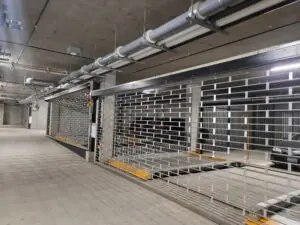
Intelligent parking systems are automated parking solutions that use mechanical, hydraulic, or electric vehicle lifting systems combined with sensors, control logic, and remote monitoring to maximize parking capacity, improve operational reliability, and reduce the physical footprint required for vehicle storage.
Unlike traditional parking garages, intelligent parking systems actively manage vehicle movement through vertical and horizontal platforms, coordinating lifts, shuttles, or stackers to place and retrieve vehicles efficiently. These systems are designed to optimize space usage, reduce human error, and maintain consistent performance even in high-density or constrained environments
Intelligent parking systems are commonly deployed as parking stackers, puzzle parking systems, or fully automated parking structures. Each configuration is selected based on building constraints, vehicle volume, access requirements, and long-term operational goals.
In the United States, companies such as The Trivial Company design, install, and service intelligent parking systems for residential, commercial, and mixed-use developments where conventional parking layouts are no longer viable.
Case Study: Intelligent Parking System at All Storage Las Vegas
Nowhere is this clearer than in The All Storage Parking System in Las Vegas, a six-level, 110-space installation that compresses what would normally require over 17,000 square feet into a footprint of just 4,140. Built for high-end vehicle storage, its tandem configuration doubles capacity in the same space while maintaining independent control and security for each vehicle bay.
When The Trivial Company was brought in to complete and optimize the project, the goal wasn’t just to finish it — it was to make it smarter. Through precise mechanical calibration, refined control logic, and a focus on seamless synchronization, the system evolved from static hardware into an adaptive mechanical environment capable of running with exceptional efficiency and minimal oversight.
Intelligence here isn’t about AI buzzwords — it’s about design that anticipates. With The Trivial Company’s Remote Access Unit for Lifts (RAUL™) providing insight into performance trends and maintenance timing, the system quietly tracks its own operational rhythm, turning raw movement into measurable data.
Frequently Asked Questions About Intelligent Parking Systems
What makes a parking system “intelligent”?
An intelligent parking system is considered “intelligent” when it actively manages vehicle movement using automation, sensors, control logic, and monitoring systems rather than relying on static mechanical operation. These systems collect operational data, coordinate lifts or platforms, and optimize space usage, reliability, and efficiency over time, allowing parking infrastructure to adapt to usage patterns instead of functioning as passive storage.
Are intelligent parking systems fully automated?
Intelligent parking systems can be fully automated or semi-automated, depending on the design. Fully automated systems require no human involvement once a vehicle is parked in the entry bay, while semi-automated systems combine mechanical automation with limited operator interaction. Both configurations use intelligent control systems to manage vehicle placement, retrieval, and safety protocols.
Where are intelligent parking systems commonly used?
Intelligent parking systems are commonly used in high-density urban environments where space constraints make traditional parking garages impractical. Typical applications include residential developments, mixed-use buildings, commercial facilities, automotive storage centers, and redevelopment projects where maximizing parking capacity within a limited footprint is critical.