
How Remote Monitoring Reduces Downtime in Automated Parking Systems
Remote monitoring gives service teams a clearer way to review equipment behavior, support troubleshooting, and communicate next steps with property staff.
For The Trivial Company, automated parking is never only a product conversation. It is also a planning, installation, service, and user-support conversation. A system can look simple from the outside, but the project team still needs to understand how vehicles move, how residents or staff will use the equipment, and how service access will be handled after turnover.
Start With the Site Conditions
The first step is to understand the site. Important details include available clear height, structural layout, driveway approach, column locations, electrical access, drainage, fire and life safety coordination, and the number of vehicles the project needs to support. These details influence whether a two-post stacker, four-post lift, puzzle system, or customized automated parking layout is the better fit.
Site conditions also affect the installation plan. Equipment needs room for delivery, assembly, adjustment, testing, and turnover. When these conditions are reviewed early, the project team can reduce rework and avoid late-stage coordination issues. This matters for both new construction and existing properties because small coordination misses can become daily operating problems once residents begin using the garage.
Plan for Real Users
Automated parking systems need to make sense for the people who will use them. Multifamily residents, property managers, maintenance teams, valet teams, and service technicians all interact with the system differently. Good planning accounts for signage, training, user flow, access control, response procedures, and what happens when a user needs help.
Turnover is especially important. A building team should know how to explain the system, where to report issues, and when to request service. A short training plan can prevent many avoidable problems during the first months of operation. It also gives property staff a common language for describing issues when they contact a service team.
Build Maintenance Into the Decision
Service access and maintenance planning should not be an afterthought. Parking stackers and puzzle systems include moving components, controls, sensors, platforms, and safety systems that need periodic inspection. A preventive service plan helps property teams document recurring issues, reduce emergency calls, and keep the equipment operating more consistently.
Maintenance planning also helps owners understand the real operating life of a system. A parking system that is inspected, adjusted, and supported on a consistent schedule is easier to manage than one that is only addressed after a failure. The goal is not just to repair equipment. The goal is to protect daily access for the people who rely on the garage.
Use the Right TTC Resource
If your team is still comparing equipment types, start with the main parking stackers page. If the project is moving toward construction, review installation service. If the system is already in operation, the preventive service page is the better next stop.
Some sites do not fit neatly into a standard product category. In those cases, customized systems may help the design team coordinate equipment options with site constraints, operations, and long term support requirements. Remote support can also improve the response path. The RAUL remote access page explains how remote visibility can support troubleshooting and escalation when a parking lift or stacker needs attention.
What to Prepare Before Reaching Out
Before contacting a parking system partner, gather the basics: project address, desired parking count, available drawings, current operating issues if the system already exists, and the timeline for design, installation, or service. If the question is about an existing system, photos, equipment model information, and a short description of the issue can help the team understand the situation faster.
For remote monitoring, the most useful conversations are specific. A clear description of the site and the operating goal helps separate general product information from practical next steps. That saves time for owners, architects, contractors, and property managers.
Talk Through the Next Step
A short planning conversation can clarify the right path. The team can review space constraints, current drawings, service concerns, or operating goals and decide whether the next step is design review, installation coordination, maintenance planning, or a site-specific system discussion.
To start that conversation, use the automated parking systems contact page. Share the project location, basic parking goal, and where the project stands today, and The Trivial Company can help point the next step in the right direction.
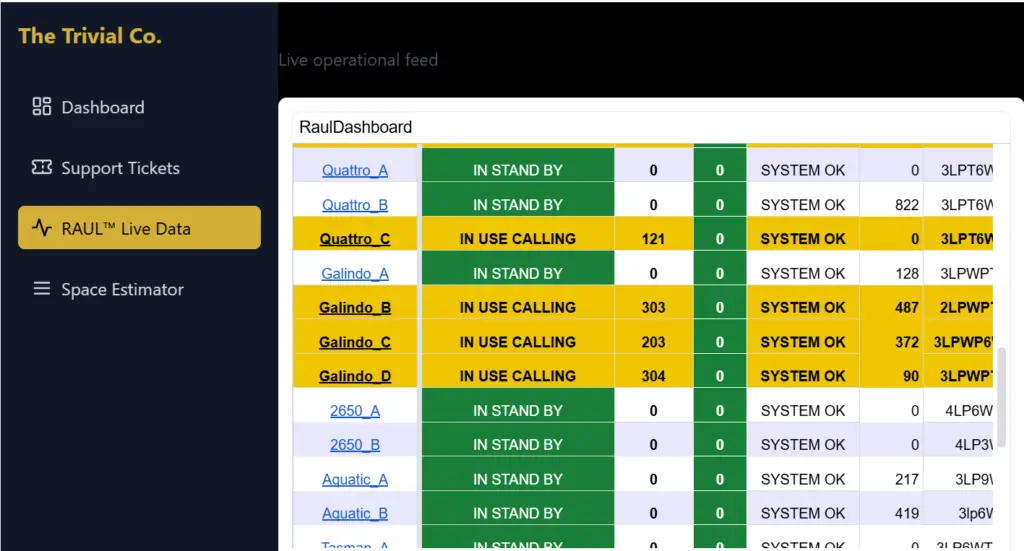
Automated parking systems solve one problem extremely well: space. But as parking density increases, reliability becomes just as critical as capacity. Even minor issues can take multiple parking spaces offline, frustrate tenants, and trigger expensive service calls.
In many cases, downtime is not caused by mechanical failure. It is caused by a lack of visibility.
The most common causes of downtime
Most parking lift interruptions stem from small, correctable issues:
- Gates left open or partially closed
- Vehicles parked incorrectly or exceeding size limits
- Temporary system errors caused by power fluctuations
- User errors that trigger safety pauses
Without real-time insight into what the system is actually doing, property managers and service teams often default to shutting everything down and calling for service.
Why on-site response is often unnecessary
When a parking system goes offline, the default response is reactive. A technician is dispatched before anyone fully understands what went wrong. This leads to delays, higher costs, and unnecessary downtime, especially after hours.
Remote monitoring changes this approach. With live system data and visual access, technicians can assess the situation immediately. Many issues can be resolved remotely by confirming safe conditions, closing unattended gates, clearing minor faults, or stabilizing power-related errors.
Systems like RAUL (Remote Access Unit for Lifts) were designed specifically to support this kind of real-time diagnosis and intervention, allowing trained operators to see what is happening before deciding whether an on-site visit is truly needed.
Continuous visibility leads to better operations
Remote monitoring is not just about faster response. It enables better long-term decision-making. When system behavior is continuously visible, patterns emerge:
- Repeated minor faults that signal adjustment or retraining is needed
- Power instability that can be stabilized before causing failures
- Usage patterns that increase wear or operational risk
Instead of reacting only after a breakdown, issues can be addressed earlier and more predictably.
Reliability matters in dense parking environments
As parking density increases, the margin for error shrinks. Automated parking systems require tools that provide ongoing visibility and control, not just emergency response.
Downtime is rarely about complexity alone. More often, it is about not knowing what is happening when something small goes wrong.