
By The Trivial Company
Published on LinkedIn — 2025
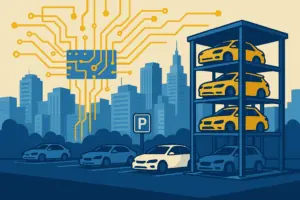 When a garage starts whispering to the city, it stops being concrete and starts becoming intelligence.
In every major city, parking remains a stubborn paradox: essential but inefficient, visible yet overlooked. For decades, it’s been a static cost — a place to leave a car, not to learn from one.
But as urban planners push for smarter, more sustainable cities, a new idea is emerging: the data-driven garage.
According to a 2025 study published in Scientific Reports, IoT-based parking networks can reduce search time by up to 35 % and cut local emissions by 20 % (Ala’anzy et al., 2025, Nature.com).
That’s not just convenience — that’s urban efficiency.
At The Trivial Company, we design, install, and service automated and semi-automated parking systems that not only move cars efficiently but collect valuable operational data. We call it Infrastructure Intelligence — because once the system starts measuring itself, it can start teaching the city how to move better.
1. The Quiet Revolution Beneath Our Cities
Traditional garages generate one kind of data: revenue from tickets. Everything else — occupancy, turnover, duration, maintenance logs — is usually lost in the concrete.
But with sensor-driven lifts, puzzle systems, and connected platforms, every stall becomes a data node.
Each vehicle’s entry and exit record tells a story: who’s coming, how long they stay, when they leave, and how the facility performs under stress. Aggregated, this information transforms parking into a mobility barometer — a real-time indicator of how people move, live, and work.
A ScienceDirect review of 240 smart-parking deployments found consistent patterns: occupancy analytics allowed cities to reallocate under-used zones and adjust pricing dynamically (Fahim et al., 2021, ScienceDirect).
The result was not merely smoother parking — it was measurable CO₂ reduction, less congestion, and better land-use decisions.
2. What Cities Can Learn from Their Garages
The garage, once a passive asset, is becoming an urban sensor.
- Occupancy as signal: When a downtown facility reaches 95 % occupancy before noon, planners can infer transit bottlenecks or event surges before they appear on the street.
- Dynamic resource allocation: Programs like SFpark in San Francisco showed that demand-based pricing reduced cruising traffic by nearly 50 % while improving space utilization (Wikipedia: SFpark).
- Land-use efficiency: Automated systems can reduce required parking footprint by 30–50 %. That reclaimed space becomes leasable square footage — an entire floor of apartments or retail that didn’t exist before.
- Infrastructure layering: Garages can double as data and energy nodes — housing EV chargers, micro-mobility stations, and air-quality sensors that feed municipal dashboards.
As Radziszewska (2023) observed in her paper Data-Driven Approach in Knowledge-Based Smart City (ECKM Conference Proceedings), “the most underutilized data is that which sits beneath our feet — literally in our infrastructure.”
Parking is one of those hidden reservoirs.
3. How Developers Are Turning Insight Into Return
Real-estate developers are quietly learning that data has a return-on-intelligence as much as return-on-investment.
For example, a 2024 TownePark Industry Report showed that smart-garage retrofits improved profitability by an average of 15 % within three years (townepark.com).
Why? Because predictive maintenance, energy optimization, and dynamic pricing all depend on data flow.
At The Trivial Company, our RAUL™ platform integrates lift diagnostics and usage analytics, reporting uptime rates above 99.9 %. Those same data streams support predictive service cycles — replacing parts before failure rather than after.
Each lift cycle, each motor start, each stall’s occupancy becomes part of a feedback loop that saves both time and square footage. Our own case studies show that when automation meets analytics, a “parking problem” becomes an urban-space solution.
4. The Road Ahead: Parking as a Digital Utility
What happens when this intelligence scales?
Cities could integrate garage telemetry into mobility platforms, allowing for real-time guidance, energy load balancing, and even carbon-credit trading.
Ford’s pilot with Bosch in Detroit demonstrated autonomous valet infrastructure that increased stall capacity by 20 % (Axios, 2020).
Imagine coupling that with live environmental and energy data: the garage as both parking and power-distribution node.
In other words, parking stops being an endpoint and becomes a sensor-grid — an essential layer in the data-driven city.
5. Building the Future, One Lift at a Time
The transition won’t happen automatically (no pun intended). It takes investment, collaboration, and a mindset shift.
Yet the payoff is undeniable: quieter streets, lower emissions, more usable space, and buildings that learn.
As we tell our partners, “You don’t just install a parking system; you install a source of urban intelligence.”
At The Trivial Company, our goal isn’t to make parking beautiful (though we do that too). It’s to make it meaningful — to help cities and developers see garages not as dead space, but as active participants in the civic network.
Because the smartest cities won’t just collect data from the sky — they’ll listen to what’s happening beneath their streets.